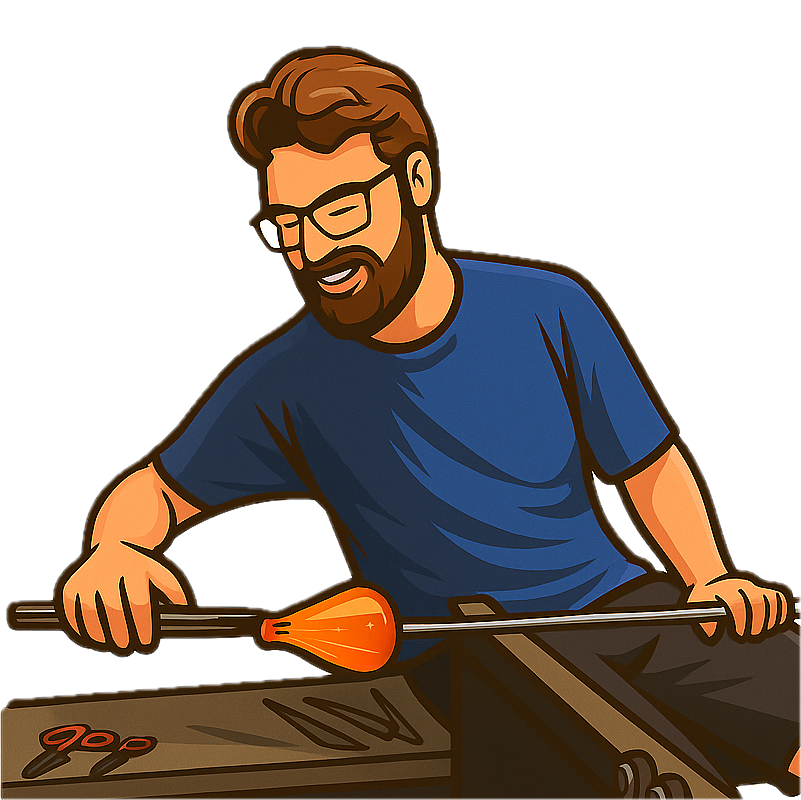

From the outside, glassblowing looks smooth and controlled. You see a piece of hot glass come out of the furnace, it gets shaped, stretched, and within minutes it starts to look like something finished. It can feel almost effortless to watch. That is part of what draws people in. But what you are seeing in that moment is built on years of learning skills that are anything but simple.
One of the most overlooked parts of glassblowing is just turning the pipe. It sounds basic, but it is not a natural movement. In order to keep hot glass centered, the pipe has to be rotating constantly. If it stops for even a second, gravity starts pulling the glass down and the entire form can shift. Learning how to turn the pipe smoothly, consistently, and without thinking about it takes years. It is one of the first skills in glassblowing, and also one of the hardest to truly master.
At the same time, you are working against the clock. Glassblowing is built around timing. Hot glass is only workable within a small window where it is soft enough to move but stable enough to control. That window is constantly closing. Every movement has to happen at the right moment. If you are too early, the glass will not respond. If you are too late, it stiffens and fights back. That level of timing is not something you can fake. It only comes from repetition and experience working with molten glass day after day.
The material itself adds another layer of difficulty. Hot glass is always moving. It responds to gravity, heat, and even the smallest changes in position. You are not shaping something that sits still. You are constantly adjusting, reading the material, and reacting in real time. Every piece of handmade glass is a balance between control and letting the material do what it wants to do.
Heat is another factor that defines the entire process. Glassblowing involves working at temperatures that most people never experience up close. The glass is glowing, fluid, and constantly changing as it cools. Managing that heat, knowing when to reheat, when to move, and when to stop, is a skill that takes years to develop. It is not just about handling the material, it is about understanding it.
There is also a level of commitment required in every step. In glassblowing, hesitation shows up immediately in the final piece. You have to make decisions and follow through with them. That confidence does not come overnight. It is built through mistakes, through pieces that do not work, and through learning how to recover when things go off track. Every experienced glassblower has a long history of failure behind the work you see.
All of these elements come together in every piece of handmade glass. When you look at a finished piece, you are not just looking at the final form. You are looking at years of developed skill. The ability to keep the glass centered, to move at the right time, to manage heat, and to make decisions without hesitation. Those are not small things. They are the foundation of the craft.
That is also why glass is often misunderstood when it comes to value. From the outside, it can look like something that was made quickly. But the reality is that the speed you see is only possible because of the time that went into learning how to work that way. What looks simple is the result of thousands of hours working with hot glass, refining movements, and understanding how the material behaves.
For me, every piece I make carries that process with it. It is shaped by timing, by control, and by the constant challenge of working with a material that never fully settles. That is what makes glassblowing so demanding, and also what makes each piece worth holding onto.
Glassblowing is harder than it looks, and that difficulty is exactly what gives the work its value.