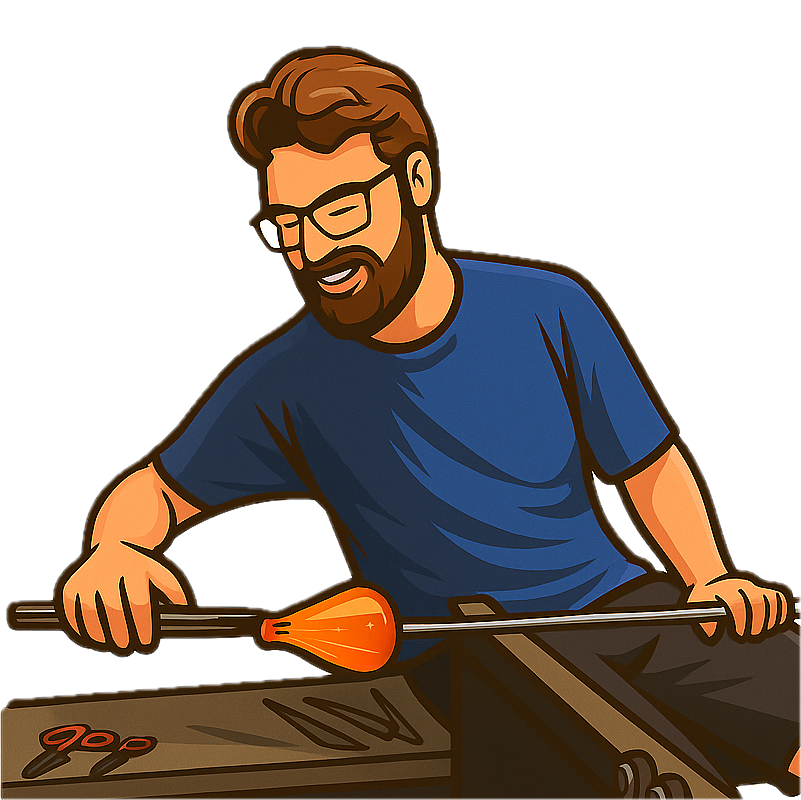

Glassblowing is already a demanding craft. It requires timing, control, heat awareness, and constant movement. Now take that entire process and put it on a moving ship in the middle of the ocean, and everything becomes more complicated. Working with hot glass onboard is one of the most rewarding things I have ever done, but it comes with a set of challenges that you do not experience in a traditional glassblowing studio.
One of the biggest differences is the equipment. On land, most glassblowing studios rely on gas powered furnaces and torches that can respond quickly and maintain heat more aggressively. Onboard, everything is electric. That changes how you work with hot glass right away. Electric furnaces take a long time to heat up, and once you open the doors, you start losing heat quickly. Every second matters. You cannot casually check the glass or leave the door open longer than needed. You have to be efficient with every movement, because the temperature drop directly affects how the glass behaves.
The same goes for tools. The only torch we are allowed to use onboard is a small MAPP gas torch, the kind most people would recognize from making crème brûlée. In a traditional hot shop, you might have larger torches that give you more control when spot heating or adjusting a piece. Here, you learn to work within limitations. You rely more on timing, on clean gathers, and on getting things right the first time, because you do not have the same ability to go back and fix something with a larger flame.
Consistency becomes another major challenge. In a land based glassblowing studio, your environment is stable. At sea, everything is in motion, even when it feels still. The ship moves, and that subtle motion affects your body and your balance. When you are shaping molten glass, even small shifts can change the outcome. You find yourself constantly making small adjustments without thinking about it, just to keep the piece centered and controlled.
Heat management is also more demanding in this environment. Glassblowing always comes down to timing, knowing when the glass is soft enough to move and when it is starting to stiffen. Onboard, that window can feel tighter. Between the electric equipment, the heat loss when doors open, and the pace of teaching glassblowing classes, you are always thinking a few steps ahead. If you miss your timing, the glass will let you know immediately.
There is also the constant presence of an audience. On a cruise ship, you are almost always working in front of people. Whether it is during live glassblowing demonstrations or while teaching a class, there are eyes on every piece you make. That adds pressure in a way that is hard to explain until you experience it. Every gather, every movement, every decision is visible. When something goes right, people see it. When something goes wrong, they see that too.
At first, that pressure can be intense. Over time, it becomes part of the process. It forces you to stay focused and committed to every piece. You learn to keep moving, to recover quickly, and to stay calm no matter what happens. In a way, it sharpens your glassblowing skills faster than working in private ever could.
Then there is the physical side of working with hot glass every day. Glassblowing is not passive. You are constantly turning the pipe, using tools, managing heat, and staying engaged with the material. Onboard, you are doing this while also teaching glassblowing classes, interacting with guests, and maintaining the studio. There are no real days off, and the schedule keeps moving. That kind of repetition builds endurance, but it also requires discipline. You have to show up ready to work, no matter how you feel.
Even with all of these challenges, or maybe because of them, working with hot glass at sea has made me a better glassblower. It forces you to adapt, to think ahead, and to trust your instincts. You learn how to work efficiently with the equipment you have. You learn how to manage heat with precision. And you learn how to perform under pressure, with an audience watching every step.
At its core, glassblowing is about working with a material that is constantly changing. Hot glass is always moving, always cooling, always responding to what you do. Working onboard just amplifies that reality. It adds another layer of unpredictability that you have to work with, not against.
That is what makes it challenging, and that is also what makes it worth it.