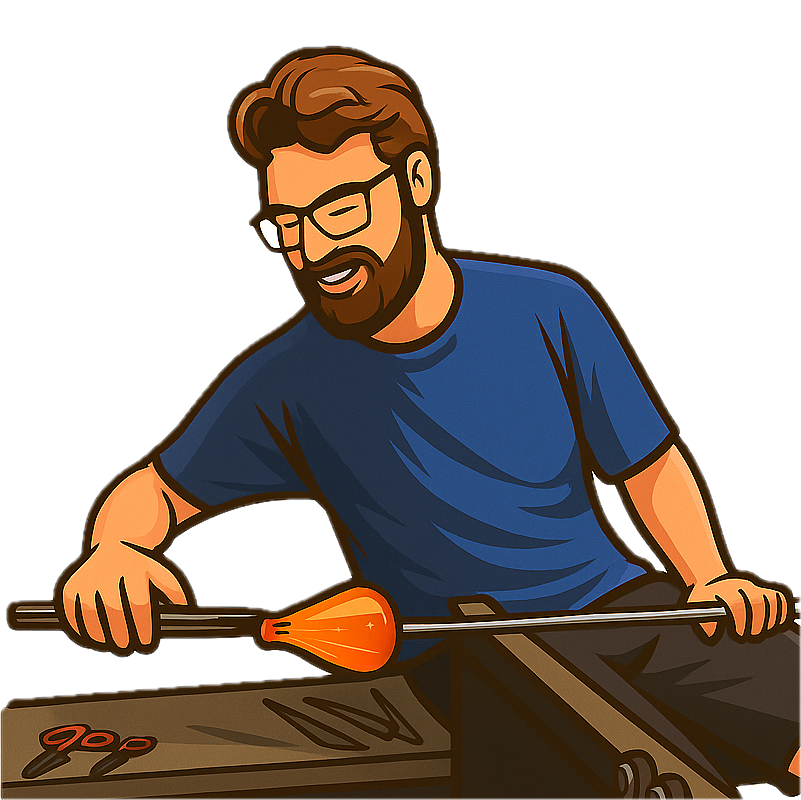

Working as a glassblower at sea sounds like a dream from the outside. You travel the world, work with hot glass every day, and get paid to create in places most people only see on a map. In a lot of ways, that part is true. This job has taken me to over 40 different countries, and what makes it even better is that I am not just passing through. I get to actually know these places. I find my favorite restaurants, the spots I go back to every time we dock, and the little routines that make each port feel familiar. And if the weather is not great or I need a reset, I can stay onboard, take a nap, and recharge before the next day in the hot shop.
At the core of it, I get to do what I love. I work with hot glass, I teach glassblowing, and I create every single day. That part never gets old. But life onboard as a crewmember comes with tradeoffs that most people never see. Every department on the ship works long hours. There are no real days off, and contracts can last anywhere from four to seven months without seeing family. You learn quickly how to build a routine in a place that never really stops moving.
Living on a ship is also a completely different lifestyle. It is honestly closer to dorm room living than anything else. Small spaces, tight quarters, and your entire world is within walking distance. Your best friends are right down the hall, and sometimes your partner is too. Because contracts are limited, relationships move fast. Friendships and working relationships develop quickly because you are spending so much time together. You rely on each other in a way that feels different from life on land.
One of the most unique parts of being a crewmember is the culture. As an American, I am usually onboard with only a small handful of other Americans. Everyone else comes from different countries, different backgrounds, and different ways of life. You are not just visiting other cultures, you are living with them every day. You share meals, stories, and routines, and over time you start to see the world from a much broader perspective. That part of the experience is hard to replicate anywhere else.
At the same time, there is a clear priority onboard. Guests always come first. That is the nature of the job. It shows up in small ways every day. We wait to get off the ship until all the guests are off, and we have to be back onboard before they return. Our schedules are built around their experience. It is part of what makes the operation run smoothly, but it is also one of the many tradeoffs that come with the job.
There are dozens of these tradeoffs. Long hours, limited space, time away from family, and constantly being in a work environment. But there are also benefits that are just as real. The ability to travel consistently, to build a global network of friends, and to grow quickly both as a person and as a glassblower. Working with hot glass in this environment forces you to adapt, to stay focused, and to keep improving no matter the conditions.
One of the biggest benefits, and something that is really unique to this kind of glassblowing, is the audience. As an artist, I get to share my craft with thousands of different people every single week. This is not like working in one town where you see the same faces over and over again. Every cruise is a completely new group of people. Every week, I get to introduce glassblowing and hot glass to people who have never seen it before, and that never gets old.
The reactions are what make it special. You see people walk up curious, not really knowing what to expect, and then you watch it click for them. The heat, the movement, the way the glass changes right in front of them. It hits people in a way they do not expect. There is a level of introspection that comes out of it too. People start asking deeper questions, not just about the process, but about the craft, the time it takes, and what it means to make something by hand.
Because of the nature of this job, I get to have those moments over and over again with completely different people. Thousands of interactions, all centered around glassblowing, hot glass, and the experience of watching something be made in real time. That kind of exposure as an artist is rare, and it has shaped how I think about my work and how I share it.
For me, it comes back to the balance. I get to live a life that is very different from the typical path. I get to create with hot glass while moving from country to country, building experiences instead of routines. It is not always easy, and it is definitely not for everyone, but it is something that has shaped both my work and who I am.
Life at sea as a glassblower is not just about the travel or the craft. It is about understanding the tradeoffs, embracing them, and deciding that the experience is worth it.